
What Should I Know?
Table sugar, scientifically known as sucrose, is composed of equal parts of glucose and fructose bonded together.
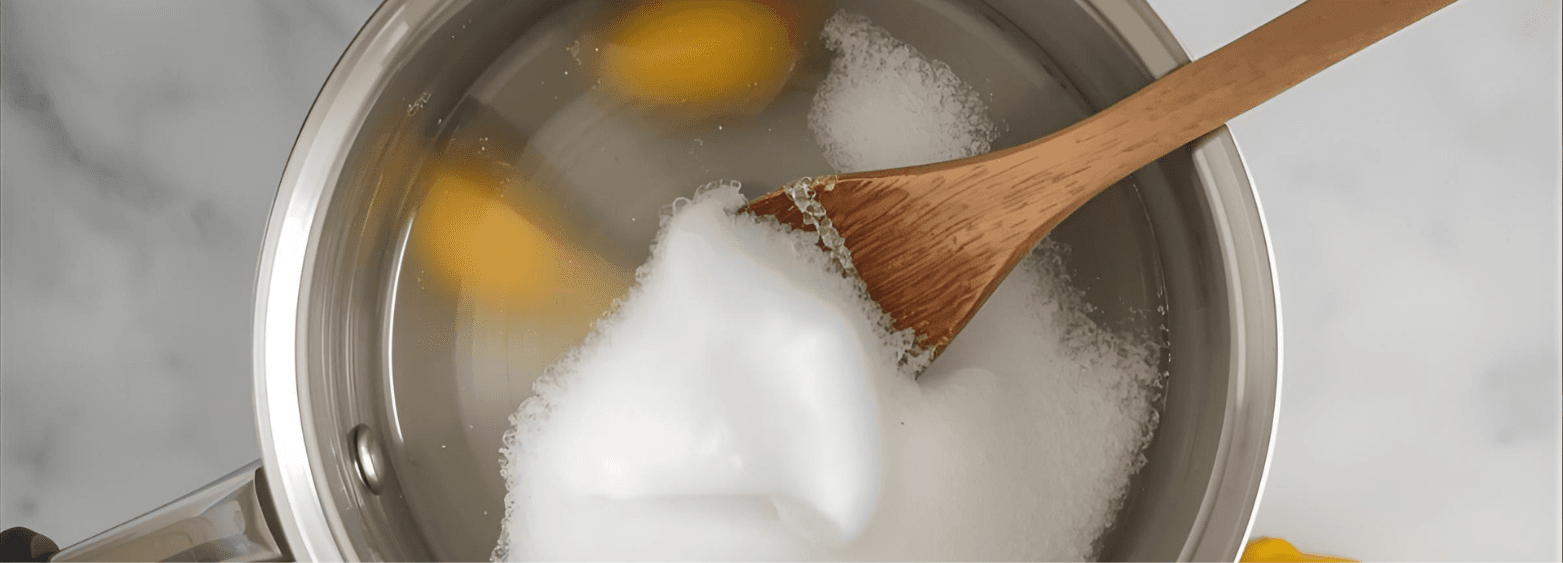
When a certain amount of sugar and water are mixed and heated, syrup is obtained.
When boiled or when too much sugar is added, sucrose molecules bond together to form crystals.
The citric acid in lemon juice helps prevent crystallization by breaking down sucrose.
Why Does It Matter?
Molecules such as fats, water, and sugar can bond and form crystals. This is desirable in some products (for example, chocolate tempering or fondant), but undesirable in others. The size of detectable sugar crystals is around 15 μm, meaning crystal structure has a major influence on food texture. For instance, good-quality ice cream should contain no crystals larger than 40 μm; otherwise, a gritty texture develops.
In syrups and hard candies, crystallization must be controlled. In hard candy production, the mixture is cooled rapidly enough to prevent crystal formation. Confectioners and cooks sometimes use ingredients such as invert sugar or corn syrup to prevent crystallization.
What Do the Rules and Science Say?
When a solution of sugar and water is heated, the bonds in sucrose break, and the molecules bind to water. Under high heat and acidic conditions, sucrose begins to hydrolyze into glucose and fructose. As heating continues and water evaporates, excess sucrose remains in the mixture, which can then recombine to form crystals.
Invert sugar, often listed on ingredient labels, is simply sucrose that has been split into glucose and fructose by heat and acid. Since the total solubility of these two sugars is higher than that of sucrose, invert sugar helps prevent crystallization. When lemon juice is added to syrup, the citric acid in the lemon and the high temperature accelerate the conversion of sucrose into glucose and fructose. As a result, there isn’t enough remaining sucrose to trigger crystal formation.
How Does It Work?
The tendency of syrup to crystallize depends on temperature, cooling rate, and stirring. Hot syrups tend to form larger crystals, while cooler syrups form smaller ones. Slow cooling allows larger crystals to develop.
Stirring also affects crystal size. Syrups that are stirred occasionally form fewer but larger crystals, while those stirred continuously and vigorously form many smaller crystals. This makes the syrup smoother and more uniform in texture.
What Are The Common Misconceptions?
“If syrup crystallizes, the sugar has gone bad.” Crystallization is not spoilage; it’s simply the dissolved sugar returning to its solid state.
“Crystallization depends only on the type of sugar.” In fact, factors like temperature, cooling rate, stirring, and the addition of acids such as lemon juice are more influential.
“Crystallization changes the taste.” The effect is primarily on texture and appearance, not on flavor.
“Crystallized syrup must be discarded.” If syrup crystallizes, you can usually fix it by adding a bit more water and lemon juice, then reheating and stirring.
Why Are We Sharing This?
Syrup-based desserts are staples of many cuisines. However, crystallization and the resulting gritty texture can diminish the overall taste experience. With this article, we aim to explain the science behind crystallization and help you achieve smoother, more delicious syrups every time you cook.