
What Should I Know?
The loofah sponge is obtained by drying a plant from the gourd family known as the sponge gourd (Luffa cylindrica).
After harvesting, the gourds are soaked in water for several days, peeled, the seeds removed, then bleached and dried in the sun. Once fully dried, they take on a porous, sponge-like form.
In its fresh form, the sponge gourd can also be eaten raw like a cucumber or cooked like a zucchini.
Loofah sponges are plastic-free, biodegradable, and renewable biofibers, making them eco-friendly.
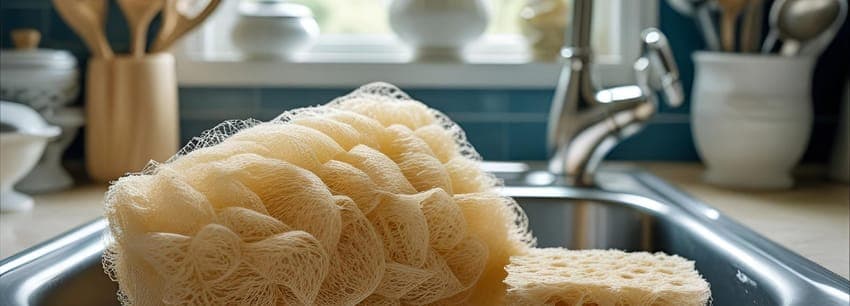
They can be used as an alternative to synthetic plastic dish sponges in the kitchen.
Their porous structure can retain moisture, which creates favorable conditions for microbial growth if not dried properly.
For safe use, loofah sponges should be dried after use, cleaned regularly, and replaced frequently.
Why Does It Matter?
The loofah sponge has gained attention as an eco-friendly cleaning tool and because of its wide range of non-food applications. It reduces plastic waste, is biodegradable, and aligns with sustainable living practices. However, improper care may lead to hygiene and safety risks.
What Do the Rules and Science Say?
There is no specific food regulation for loofah sponge use in kitchens. However, like all cleaning tools that come into contact with food surfaces, loofah sponges must comply with basic hygiene and food safety practices.
Scientific studies show that if loofahs remain damp, they can provide a breeding ground for pathogenic bacteria.
Mold growth or unpleasant odor are signs that the sponge should be discarded.
How Is It Made?
Sponge gourds are soaked in water for several days, peeled, and the seeds removed. After bleaching, they are left to dry completely in the sun, forming the fibrous structure that becomes the loofah sponge.
Why Does It Feel This Way?
The loofah sponge’s network of fibrous veins gives it a porous and firm texture. This allows liquid to pass through easily and also creates a gentle exfoliating effect, which is why it is used in both cleaning and personal care.
What Are the Misconceptions?
Many assume loofah sponges are completely hygienic, but if not properly cleaned and dried, bacteria and mold can grow.
They are often thought to be used only in the kitchen, but they also serve in personal care, industrial cleaning, packaging, cushioning, and even filtration.
Why Are We Sharing This?
Loofah sponges are increasingly preferred in kitchens due to their natural and eco-friendly qualities. However, lack of awareness about their proper care and limited lifespan can lead to misuse. This article aims to explain the correct ways to use loofah sponges and highlight their potential risks and benefits.