
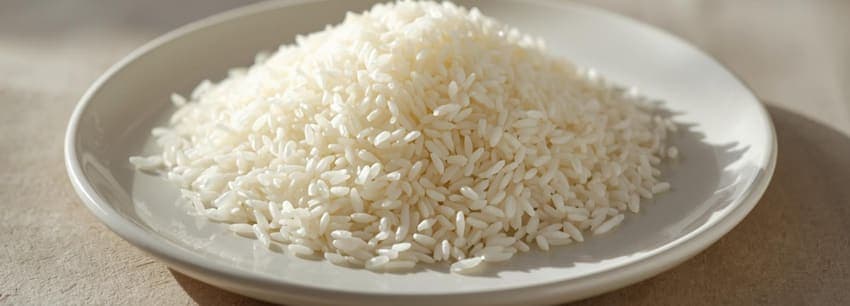
Basmati Rice: The Aromatic Grain with a Distinct Identity
A Closer Look

Basmati Rice: The Aromatic Grain with a Distinct Identity

EEditor TeamOctober 26, 2025

What Should I Know?

  • Basmati rice is an aromatic variety with a distinct fragrance caused by high levels of 2-acetyl-1-pyrroline.

  • It contains more amylose than many other rice types, giving it a lower glycemic index (GI).

  • Traditionally grown in specific regions of India and Pakistan, it holds protected geographical indication (PGI) status in global markets.

  • Some Basmati products undergo parboiling, a steaming process that further lowers the GI.


Why Does It Matter?

Basmati is valued for both its nutritional profile and unique aroma. Its lower GI helps maintain more stable blood sugar levels, while its fragrance makes it a culinary favorite worldwide.


What Do the Rules and Science Say?

In the EU, only rice from designated areas of India and Pakistan can be marketed as “Basmati” under PGI rules. In the USA, there is no PGI protection, but it is subject to food labeling standards. Scientific studies confirm that higher amylose content and parboiling slow starch digestion, reducing glycemic response.


How Is It Made / How Does It Work?

Basmati is grown under specific agro-climatic conditions. When parboiled, it is soaked, steamed, and dried — a process that helps retain nutrients and can lower GI by up to 30% compared to raw rice.


Why Does It Taste or Feel This Way?

Its nutty, popcorn-like aroma comes from elevated 2-acetyl-1-pyrroline levels. High amylose content prevents stickiness after cooking, and a moderate gelatinization temperature ensures the grains stay soft even when cooled.


What Are the Common Misconceptions?

  • Not all Basmati rice is parboiled; both raw and parboiled versions exist.

  • Aromatic rice is not limited to Basmati; Jasmine rice is another well-known example.


Why Are We Sharing This?

“Aromatic” is often used as a marketing claim without context. By explaining what makes Basmati unique, we help consumers make informed decisions based on both nutrition and flavor.

Prepared by Editor Team according to our Publishing Policy

Last revised on December 8, 2025.

References & Sources

  1. Verma, D. K., & Srivastav, P. P. (2017). Proximate composition, mineral content and fatty acids analyses of aromatic and non-aromatic Indian rice. Rice Science, 24(1), 21–31.

  2. Ahuja, S. C., Ahuja, U., & Ahuja, S. (2019). History and folklore of Basmati Rice. Wheat and Barley Research, 11(3).

  3. Bligh, H. F. (2000). Detection of adulteration of basmati rice with non-premium long-grain rice. International Journal of Food Science and Technology, 35(3), 257–265.

  4. Siddiq, E. A., Vemireddy, L. R., & Nagaraju, J. (2012). Basmati Rices: Genetics, Breeding and Trade. Agricultural Research, 1, 25–36.

  5. Buttery, R. G., Ling, L. C., Juliano, B. O., & Turnbaugh, J. G. (1983). Cooked rice aroma and 2-acetyl-1-pyrroline. Journal of Agricultural and Food Chemistry, 31(4), 823–826.

  6. Bhattacharjee, P., Singhal, R. S., & Kulkarni, P. R. (2002). Basmati Rice: A Review. International Journal of Food Science and Technology, 37(1), 1–12.

  7. Kumar, A., Lal, M. K., et al. (2022). Effect of parboiling on starch digestibility and mineral bioavailability in rice. LWT, 156, 113026.

  8. Jones, J. M. (2023). Glucose and its polymers. Encyclopedia of Human Nutrition, 412–421.

  9. Frost, G., & Dornhorst, A. (2013). Glycemic index. Encyclopedia of Human Nutrition, 393–398.

  10. Ashfaq, M., Haider, M. S., Saleem, I., et al. (2015). Basmati – Rice a Class Apart (A review). Journal of Rice Research, 3, 156.

  11. Kale, S. J., Jha, S. K., et al. (2015). Soaking induced changes in chemical composition, glycemic index and starch characteristics of Basmati Rice. Rice Science, 22(5), 227–236.

Other Articles You Might Be Interested In